
Five Notes That Never Let You Down
Why the pentatonic scale is the first thing every guitarist learns, the reason your early solos sound good, and the quiet lesson it keeps teaching you for the rest of your playing life

There is a moment that almost every guitar player remembers. You have been strumming chords for a few weeks or a few months, and then someone shows you a simple shape on the neck, a little box of five notes, and tells you that you can play any of them over a backing track and it will sound right.
You try it. You are nervous, expecting the usual wrong notes. But it works. Suddenly you are not just playing the guitar, you are saying something with it. You are improvising. For a lot of players, that box of notes is the first time the instrument feels like it belongs to them.
That box is the pentatonic scale, and it is the single most important scale a guitarist ever learns. The word comes from the Greek, penta meaning five and tonic meaning tone. Five notes. Where the major and minor scales most of us grow up hearing use seven notes per octave, the pentatonic uses only five.
That is the whole trick, and it is why the scale is so forgiving. The two notes that get removed are exactly the ones most likely to clash and sound sour when a beginner lands on them at the wrong moment. Take those two landmines out and what is left is a scale where it is genuinely hard to sound bad.
That forgiveness is the reason it gets taught first. When a new player improvises over a seven-note scale, they regularly hit one of the tense notes at a bad time, and the whole thing falls apart, and they lose their nerve. The pentatonic removes that fear.
It hands a beginner a small set of notes that sound musical almost no matter what order you play them in, over almost any chord in the key. You can start making real music with it inside a single practice session, and that early thrill is what keeps people playing long enough to get good at everything else.
In that sense, the pentatonic is not just a scale. It is the doorway.
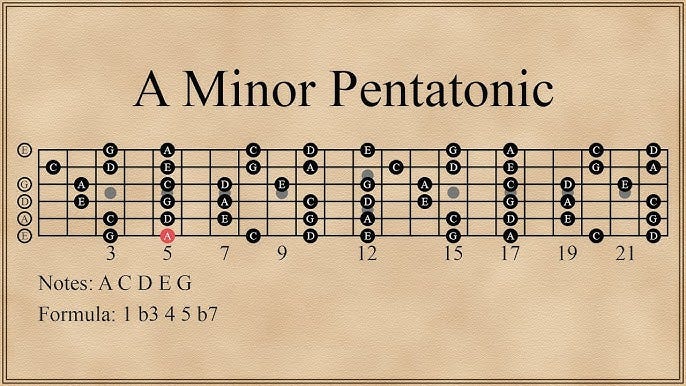
There are two flavors of it, and it is worth knowing both even at the start. The minor pentatonic is the famous one, the dark, soulful, bluesy shape behind the vast majority of rock and blues solos. When you picture an electric guitar wailing out a gritty lead with big string bends, you are picturing the minor pentatonic.
The major pentatonic is its brighter, happier cousin, the one that leans toward country and pop. Most players begin with the minor shape in what is often called the first box, usually learned in A minor at the fifth fret, because that one shape unlocks the sound everyone came to the guitar wanting to make.
And here is the part that makes the scale so practical. It is a movable shape. Learn the box once, and you can slide the exact same fingering up and down the neck to play in any key. The shape never changes. Only its position does.
Learn it in A minor at the fifth fret, move it down to the third fret, and now you are in G minor, same fingers, same feel.
Once you have that box, you add one more note and something magical happens. Drop a single extra note into the minor pentatonic, the flattened fifth, often called the blue note, and the scale turns into the blues scale. That is all the blues scale is: the pentatonic box with one note added.
The blue note is a passing tone. You move through it; you do not sit on it, because lingering on it sounds wrong, while a quick pass through it sounds like every great blues lick you have ever heard.
That one extra note is where a huge amount of the emotional flavor of rock and blues guitar lives, in the bends and slides that brush past it. Learn the pentatonic first, then add the blue note once the box feels solid under your fingers.
If you want proof of how far five notes can carry you, listen to the players who built entire careers on this scale. Jimmy Page used the E minor pentatonic for his solo on “Good Times Bad Times,” the very first Led Zeppelin song the world heard.
Jimi Hendrix reached for the E minor pentatonic in his solo on “Hey Joe.” Billy Gibbons built the unmistakable riff of ZZ Top’s “La Grange” out of the A minor pentatonic.
B.B. King spent a lifetime wringing more feeling out of the minor pentatonic than most players get out of every scale combined, and you can hear it all over “The Thrill Is Gone.”
David Gilmour of Pink Floyd made a whole signature style out of playing these notes slowly, bending them, letting them breathe, saying more with a handful of pentatonic notes than a faster player says with a hundred.
Chuck Berry, Angus Young, Slash, Stevie Ray Vaughan- the list of players whose sound is rooted in this scale is essentially the history of rock guitar.


Which brings us to the strange truth at the heart of the pentatonic scale, the reason it is both the first thing you learn and the last thing you master. The scale is easy. What you do with it is not. Because the materials are so simple, so stripped down, almost all of the sound depends on how you use the few notes you have.
There is nowhere to hide. A beginner and a master can be playing the exact same five notes, and the difference between them is total. It is not in the notes. It is in everything around the notes.
That everything is what takes a lifetime. It is phrasing, the way you group notes into little sung sentences instead of running the scale up and down like a finger exercise. It is knowing when to leave a gap, because the silence between phrases makes the notes you do play sound confident and deliberate rather than nervous and endless.
One of the most common beginner mistakes is simply never stopping, filling every second with notes. Learning to pause is harder than learning to play. It is rhythm, the discovery that changing only the timing of the same five notes completely changes how the line feels.
It is call-and-response, playing a phrase and then answering it, the way a singer would. It is targeting, learning to land on the strongest note as a chord changes underneath you so your solo follows the song instead of floating on top of it.
It is the bends and the slides and the vibrato, the physical touch that makes one player’s pentatonic sound like crying and another’s sound like a warm-up drill.
This is why teachers who have watched thousands of students often say there are two kinds of guitarists: the ones who avoid the pentatonic because they think it is too simple and beneath them, and the ones who lean on it as a crutch because it is easy and never push past that first box.
The players who rise above both groups are the ones who understand that simple does not mean finished. They learn to move the scale across the entire neck rather than staying trapped in one shape. They practice soloing on just two strings to force themselves to find the music rather than the pattern.
Some of them go further and try singing the scale, letting their own voice suggest the melody instead of their fingers falling into the same familiar runs. The goal is not more notes. The goal is more meaning from the notes you already have.
There is a lesson buried in all of this that reaches past the guitar. The pentatonic scale teaches you that mastery is rarely about acquiring more. It is about doing more with less. A beginner wants the next scale, the next trick, the next shape, always reaching for more vocabulary.
The master returns to the same five notes they learned in their first week and discovers something new in them after thirty years. The scale never gets bigger. The player does. What changes is not the tool but the hand that holds it, the ear that guides it, and the patience to say one true thing instead of ten empty ones.
So if you are just starting out, learn the pentatonic box first. It will give you the fastest taste of the real thing, the feeling of making music instead of practicing it. And if you have been playing for years, go back to that same little box and sit with it.
Play it slower. Leave more space. Bend one note until it sings. You will find, as every great player eventually does, that those five simple notes were never simple at all. They were only waiting for you to catch up to them.